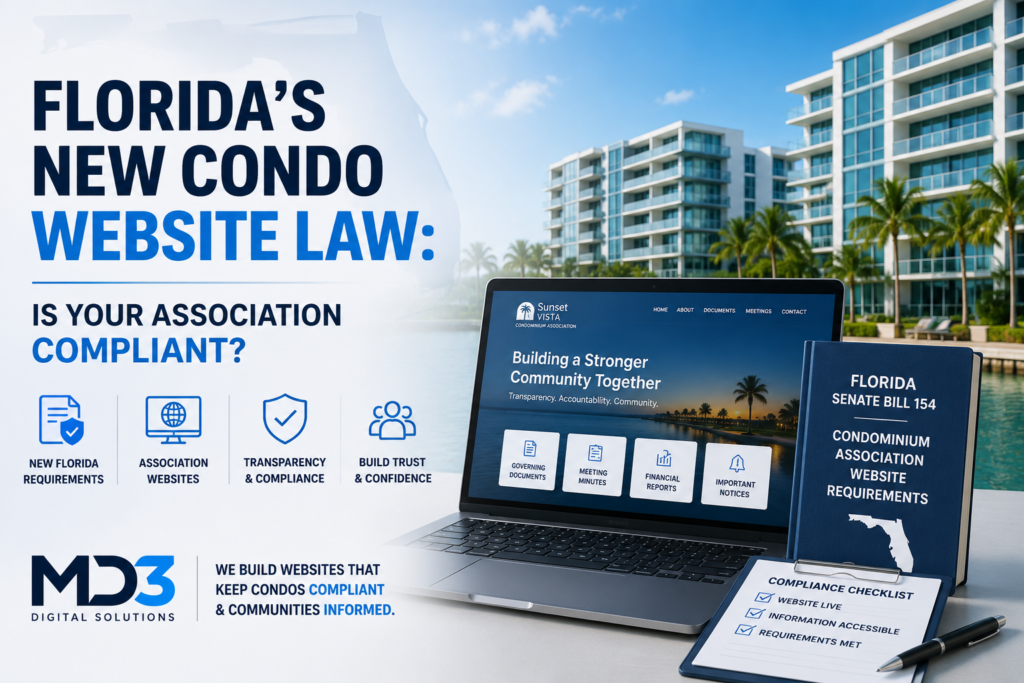
If you sit on a condo board in Florida, you’ve probably already heard the rumor going around your building: “The association needs a website now; it’s the law.” That rumor has a name — Florida’s New Condo Website Law — and it’s true. If your community has 25 units or more, the deadline for it has already passed.
Here’s what actually changed, what your board needs to post, and why a website generic enough could still land you in trouble.
Florida amended Chapter 718 of the Florida Statutes — specifically Section 718.111 — to lower the website requirement threshold from 150 units down to just 25. That’s a massive jump in how many associations are now on the hook. A mid-size building that never gave this a second thought two years ago is suddenly required by law to maintain a secure, online records portal.
The compliance deadline was January 1, 2026. If your association crossed the 25-unit line and hasn’t set anything up yet, you’re not early anymore — you’re behind, and owners (or their attorneys) are allowed to notice.
This isn’t a “put up a homepage and call it done” situation. The statute is specific about what unit owners need to be able to access, and it has to sit behind a secure, password-protected owner login — not just floating publicly on the internet. At minimum, boards need to post:
And here’s the part boards keep underestimating: new records have to go up within 30 days of being created or received. This isn’t a once-a-year upload chore. It’s an ongoing obligation, and a management company juggling a dozen properties can lose track of it fast.
We’ve already gone through this exact process with a real association — 6830 Indian Creek Club & Marina Condominium Association North rebuilt their entire site on WordPress with us, and compliance was the whole point of the project, not an afterthought bolted on at the end. That work turned into something we now offer as its own product: a WordPress plugin built specifically for Florida condo and HOA compliance.
We built it because the alternative — a generic file-sharing folder, or a website builder never designed with a statute in mind — creates more risk than it solves. A Dropbox link isn’t a “secure owner portal.” A PDF dumped into a blog post isn’t organized recordkeeping. Boards need something that maps to the law itself.
Built on real projects like 6830 Indian Creek Club & Marina — not a generic template. Every feature below maps to something a Florida condo board actually needs.
Every file gets filed under its own category: Contracts, Bids, Bylaws and Amendments, Annual Budget, 40 Year Recertification, Financial Reports, Insurance Policies, Meeting Notices, and more. The documents can be filtered by category or date, searchable by title.
Upload a document, then check off exactly which roles get to see it — Owner, Manager, or both. Board members, building managers, and admins have access by default, so the board never locks itself out of its own contract by accident.
The board can message one owner, a handful of them, or an entire role — all Renters, all Owners — from the same dashboard where the documents live. No separate mailing list to maintain.
Electric, plumbing, elevator, locksmith, fire alarm, fire sprinkler and pumps — whoever the board needs to call at 2am is one click away instead of buried in someone’s phone. The statute doesn’t require this one. Owners notice it anyway.
Board Member, Renter, Owner, Manager, Building Manager — the dashboard shows a running count of each, with one-click access to add a new user or pull up the full list.
Your association isn’t locked into a proprietary platform you can’t leave. It’s your site, your domain, your content — we just handle the compliance layer and the build.
Faster to launch than a custom build, but if you need to extend the plugin with custom features, we can do it for you
Call MD3 Digital Solutions Inc. at 786-757-4345 or email [email protected]
Nobody wants to be the board member who gets a formal complaint, or worse, ends up explaining to fellow owners why the association is out of compliance with state law. Fixing this after the fact — scrambling to organize years of contracts and minutes under a deadline — is a much worse project than doing it right the first time.
If your association hit 25 units and you’re not sure whether your current setup actually satisfies Section 718.111, it’s worth a real conversation, not a guess.
Florida’s new condo website law is the 2024 amendment to Florida Statutes §718.111 that requires condominium associations with 25 or more units to maintain a secure website with a password-protected owner portal. It replaced the old 150-unit threshold, which is why so many mid-size buildings got caught off guard.
If you’re a condominium with 25 or more units, yes. If you’re an HOA instead of a condo, the threshold is different — 100+ parcels, required since January 1, 2025 under a related statute.
Probably, if the compliance deadline of January 1, 2026 has come and gone and nothing’s up. The statute doesn’t give a grace period for “we’ve been meaning to.”
Technically, you could try, but it’s risky. Florida’s new condo website law calls for a secure, password-protected owner portal — a public Google Drive link that anyone with the URL can open doesn’t meet that bar, and neither does a Wix page with no login. Boards that go this route often end up rebuilding within a year anyway.
The statute requires records within 30 days of creation or receipt, but none of the legal sources we reviewed spell out a specific fine or penalty for missing that window. That said, “no explicit fine” isn’t the same as “no consequence” — a board out of compliance is exposed to owner complaints and, in a dispute, gets a much weaker position. We wouldn’t bank on the lack of a stated penalty.
New records need to go up as they’re created. But owners can also request historical documents, and having your governing documents, past budgets, and recent meeting minutes already organized on day one saves your board a lot of scrambling later.
Some management platforms include an owner portal, and if yours already satisfies the document categories and access rules under Florida’s new condo website law, you may be covered. A lot of boards assume they’re covered and aren’t — worth a quick check against the list in this post rather than assuming.
Depends on the scope. A public site plus the compliance portal for a single association is a very different job than a from-scratch custom build, and that’s part of the point of building it as a WordPress plugin. Reach out and we’ll give you a real timeline for your build, not a generic estimate.
If your current site isn’t on WordPress, we’d migrate it — that’s exactly what we did for 6830 Indian Creek. If you already run WordPress, the plugin can often be added to what you have.
MD3 Digital Solutions Inc. builds and manages WordPress websites for Florida condo and HOA associations, including the compliance plugin described above. If you want to know whether your current site meets the requirements — or you need one built from scratch — give us a call.
Sources: Becker & Poliakoff, Florida Condo & HOA Law Blog, Eisinger Law, Siegfried Rivera, Condominium Associates. This post is general information, not legal advice — associations should confirm their specific obligations with legal counsel.
AI assistant — answers may be inaccurate.